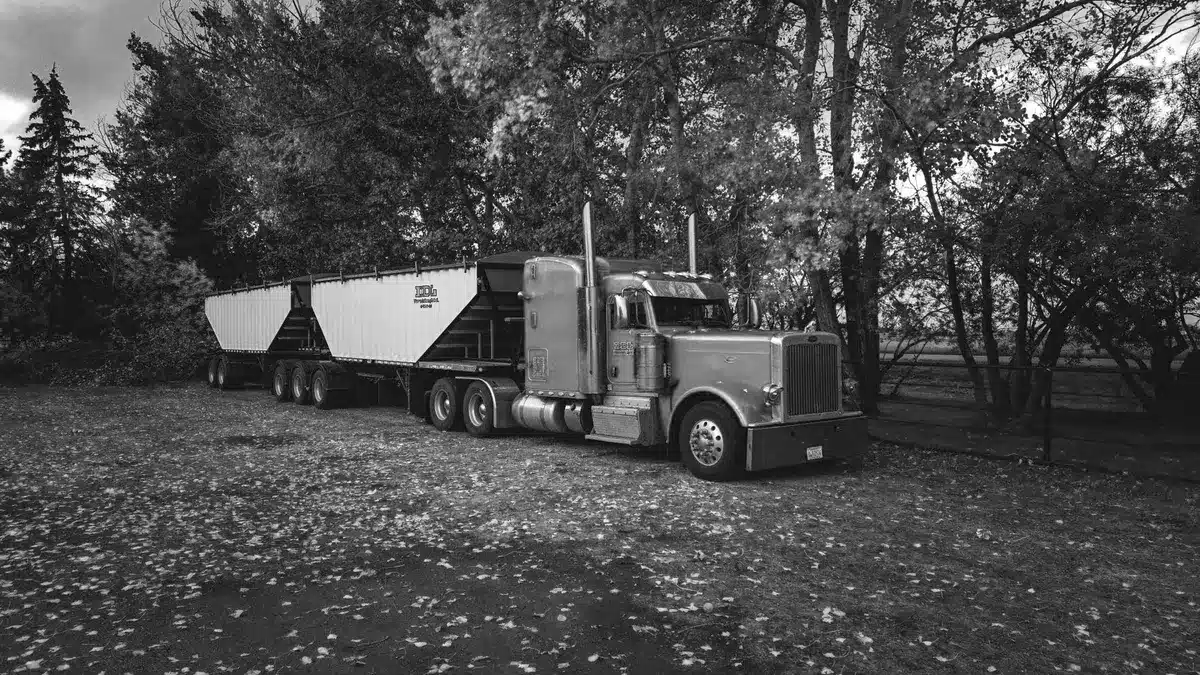
Why truck blind spots and wide turns need careful investigation
Truck blind spots and turning geometry can be central to understanding a collision. A long trailer does not follow exactly the same path as the cab. The available view can also change as the truck moves. Those characteristics are reasons for careful operation and investigation, not a complete answer about who was responsible.
Understanding the truck’s movement can reveal responsibility that a brief accident description misses. If an insurer says only that the smaller vehicle was in a blind spot, I want to examine when it entered that area and what the truck driver could have observed before the maneuver.
The trailer follows a different path
During a turn, the trailer’s rear wheels may travel inside the path taken by the tractor. This is commonly called off-tracking. A truck may need additional space to complete a turn, and its movement can be difficult for another road user to interpret from a brief glance.
The precise path depends on the equipment and the roadway. Trailer length and intersection layout can affect the space involved. We should use the actual vehicle dimensions and scene information rather than assume that every tractor-trailer follows the same path.
A recording that begins before the turn can be particularly useful. It may show lane position and how surrounding traffic developed. A still photograph after the crash may document the final positions without explaining how they came to be there. Both can matter, but they answer different questions.
Visibility needs a timeline
Truck blind spots are not fixed explanations for everything that happens beside a vehicle. A person or car may have been visible before the turn began. The relevant question may be whether the driver checked at a time when the other road user could have been seen.
Mirrors and cameras have limits, and their condition and placement may matter. If an electronic warning was available, we need to know what the system could detect and whether it operated. The presence of technology should not be treated as proof that it captured every hazard.
FMCSA’s safety guidance recognizes the visibility and turning challenges of large vehicles. In a legal claim, that general guidance must be connected to the actual maneuver. The investigation should explain what information was available and what a reasonably careful driver could have done with it.
A turn signal is one part of the evidence
A signal can help explain the driver’s intended movement. It does not, by itself, show that the turn could be completed safely. We still need to understand lane position, timing and the surrounding traffic. A truck’s need for room should be evaluated alongside the care required in using that room.
The actions of the smaller road user also need fair consideration. An insurer may raise comparative fault, but that position should be tested against the evidence. Being beside a truck does not automatically resolve the issue against an injured motorist or cyclist.
I look at the whole sequence rather than select a single moment that appears favorable to one side. A complete recording may show why someone entered a particular position or why there was little opportunity to respond. Context can materially change the assessment.
Preserve the truck and the surrounding evidence
The tractor and trailer may contain electronic information relevant to the maneuver. Nearby cameras or witnesses may provide another view. Identifying these sources early allows appropriate preservation requests before routine retention or repair changes the evidence.
The vehicle itself may help establish mirror configuration or contact points. Roadway measurements may help a qualified reconstruction professional evaluate the path. The scope of expert work should follow the disputed issue rather than assume every case requires the same level of analysis.
If you have photographs or witness information, preserve them in their original form. You do not need to return to an unsafe intersection to obtain more. Let the lawyer assess what investigative work is appropriate and who can perform it safely.
The commercial operation may add relevant context
The driver’s training and familiarity with the route may be relevant where the maneuver required particular care. Dispatch information can identify the trip and the carrier involved. These records can help explain the operation without assuming that a business practice caused the collision before it has been examined.
Different companies may own the tractor and trailer. That matters when identifying who holds the records and who was responsible for particular equipment or decisions. The investigation should trace the actual roles rather than rely solely on the largest name visible on the vehicle.
Applicable state traffic law and commercial-vehicle rules need to be considered with those facts. Not every safety recommendation is a legal requirement, and not every regulatory issue contributed to the crash. A focused analysis connects the supported duty to the movement that caused the injury.
Bring the question back to what can be proved
Truck blind spots can explain why a maneuver required attention. They should not end the investigation before the available evidence is reviewed. I want to know what the driver could see, how the turn developed and what opportunity existed to prevent the collision.
If you were injured beside or near a turning truck, you may have only a brief account of what occurred. That is enough to begin identifying the sources that could clarify it. Careful investigation can turn an uncertain description into a supported explanation of responsibility.
Sources and Further Reading
About Michael B. Fusco
Michael B. Fusco is a New Jersey personal injury attorney certified by the Supreme Court of New Jersey as a Civil Trial Attorney. Read Mike’s biography and credentials.
Discuss Your Personal Injury Questions
If you have questions about an injury in New Jersey, I am happy to discuss what happened and the options the facts may support. You do not need to have every document or answer before contacting us. Call 732-465-8733 or contact Fusco Law for a free personal injury consultation.
General Information
This article provides general information, not legal advice for a particular situation. Laws and policy terms must be applied to the actual facts. Reading this article or contacting the firm does not, by itself, create an attorney-client relationship.