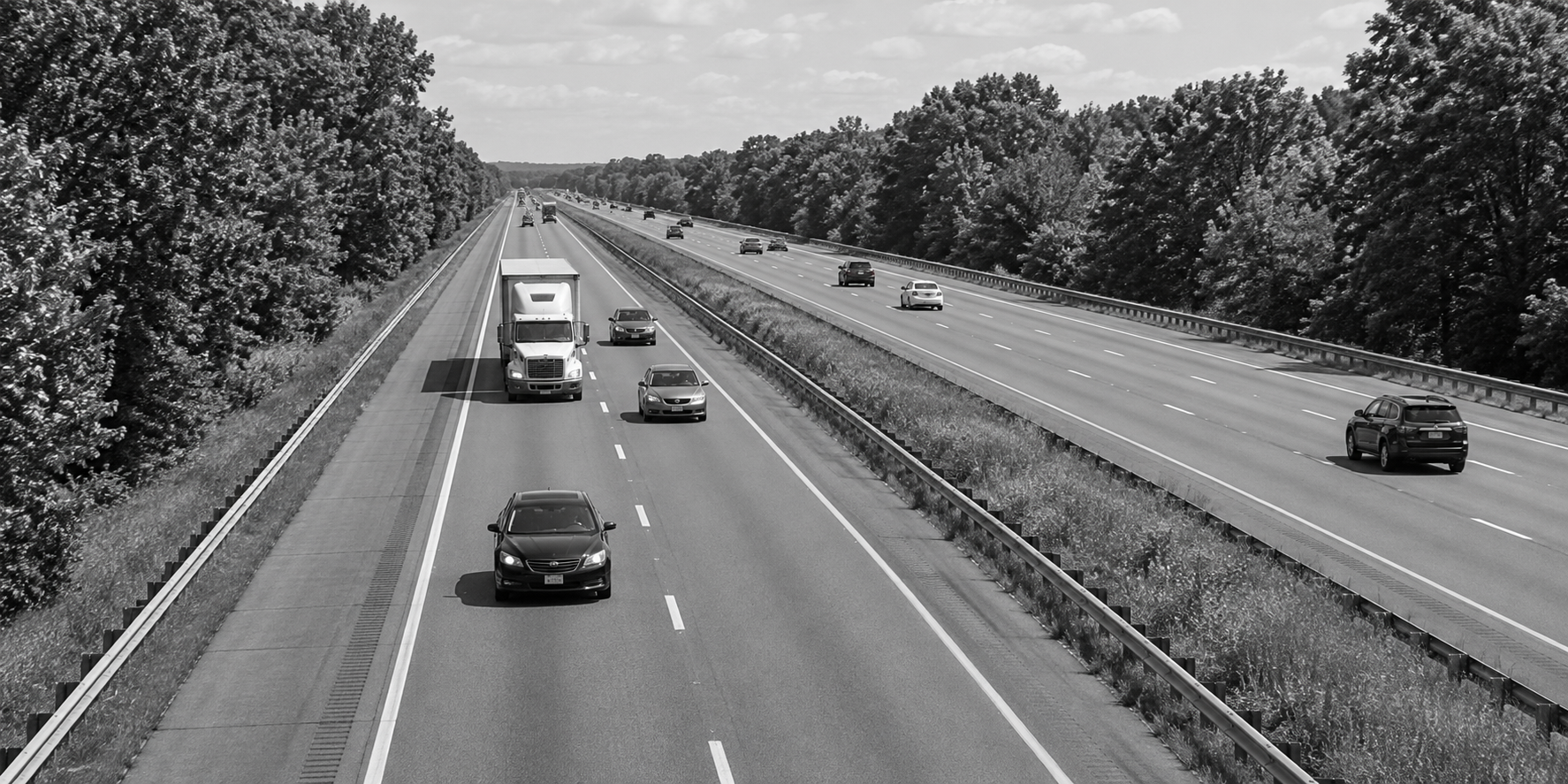
A Parkway accident begins with the driving evidence
After a Parkway accident or a collision on the New Jersey Turnpike, the first question is what caused the impact. Another driver's conduct is often the central issue. A commercial vehicle or a work-related trip may also lead to additional insurance and responsible parties worth investigating.
The road's name does not determine the claim. I want to know which vehicles were involved, where they were traveling and how the sequence unfolded. That information helps identify the people and businesses whose conduct should be examined.
The right evidence can turn a confusing highway collision into a clear account of responsibility. You may remember only part of a fast-moving event, especially when you were hurt. Other records and witnesses can help develop the parts that were difficult to observe.
Your safety comes before collecting photographs
Highway shoulders and travel lanes can remain dangerous after a collision. Contact emergency services when needed and follow the instructions of responding personnel. Do not walk into traffic to photograph damage or retrieve something from the road. Evidence can be useful without putting you at further risk.
If someone safely obtained photographs, preserve the originals. Images showing vehicle positions and the surrounding roadway may help explain the incident. A close view of damage serves a different purpose from a wider image showing an exit or lane arrangement. Both can be helpful when they already exist.
Tell the responding officer what you personally remember. If you are uncertain whether there were two impacts or three, explain that uncertainty. A later investigation can compare the accounts. You do not need to fill every gap at the roadside, and an accurate limited account is more useful than an estimate presented as certainty.
Reconstructing a multi-vehicle collision
A rear impact can push one car into another. A lane change can cause several motorists to react. The order matters because the vehicles may have contributed to different parts of the event. I review each account against the physical evidence rather than treating all vehicles as equally responsible simply because they were present.
The police report is an important starting point, but it may not contain every witness or every observation. An officer arriving after the collision is often working from statements and physical conditions. That information can be supplemented as the case develops.
A reconstruction expert may be useful when vehicle movement or a technical issue remains disputed. The need depends on the facts and the seriousness of the claim. The purpose is to answer a material question in a way that can be explained clearly, not to make an ordinary collision unnecessarily complicated.
Finding the coverage behind the vehicles
The at-fault driver's liability insurance should be identified. If a vehicle was being used for employment or a commercial delivery, the trip's purpose deserves attention. Ownership and permission to use the vehicle can also matter. These facts may reveal coverage that is not obvious from the first insurance card exchanged.
Your own benefits should be reviewed separately. PIP can address covered medical expenses without waiting for the liability dispute to end. Underinsured motorist coverage may become important if the responsible driver's limits are inadequate, subject to the policy and New Jersey law.
Before signing a release, I want to understand whether another recovery route needs to be preserved. A quick offer can be evaluated without rushing through that review. The question is whether the proposed agreement makes sense in light of the injury and the coverage investigation.
Preserving highway evidence promptly
Nearby vehicles may have dashcam footage. A commercial vehicle may have its own recording or data system. Toll or dispatch records sometimes help establish timing. Availability varies, and a camera visible near the roadway does not necessarily mean a recording exists.
It helps to identify the direction of travel, approximate mile marker and nearest exit. Those details can narrow a request. A generic request for every camera on the Turnpike is much less useful than one connected to the time and place of the collision.
A preservation request asks that relevant information be retained. It does not guarantee access or prove that the requested material exists. Obtaining the evidence may require consent or formal discovery. Prompt attention still matters because ordinary retention periods can pass while an injured person is concentrating on treatment.
When a roadway condition also needs review
If the facts point to a construction setup or a specific physical condition, the contractor responsible for that area may need to be identified. Contracts and maintenance records can help establish who controlled the work. The condition must have a supported connection to the collision.
Claims against public entities are governed by separate rules and immunities. A formal notice is generally required within 90 days of accrual, with limited exceptions. An ordinary crash report is not a substitute. That issue should be addressed promptly when supported by the facts, even while the main investigation focuses on negligent drivers or private businesses.
For most readers, the immediate concern is obtaining care and understanding how to pursue the injury claim. A Parkway accident investigation should develop the available evidence, identify the relevant insurance and explain the next step. You can bring what you have and let the remaining questions guide the work.
Sources and Further Reading
About Michael B. Fusco
Michael B. Fusco is a New Jersey personal injury attorney certified by the Supreme Court of New Jersey as a Civil Trial Attorney. Read Mike’s biography and credentials.
Discuss Your Personal Injury Questions
If you have questions about an injury in New Jersey, I am happy to discuss what happened and the options the facts may support. You do not need to have every document or answer before contacting us. Call 732-465-8733 or contact Fusco Law for a free personal injury consultation.
General Information
This article provides general information, not legal advice for a particular situation. Laws and policy terms must be applied to the actual facts. Reading this article or contacting the firm does not, by itself, create an attorney-client relationship.