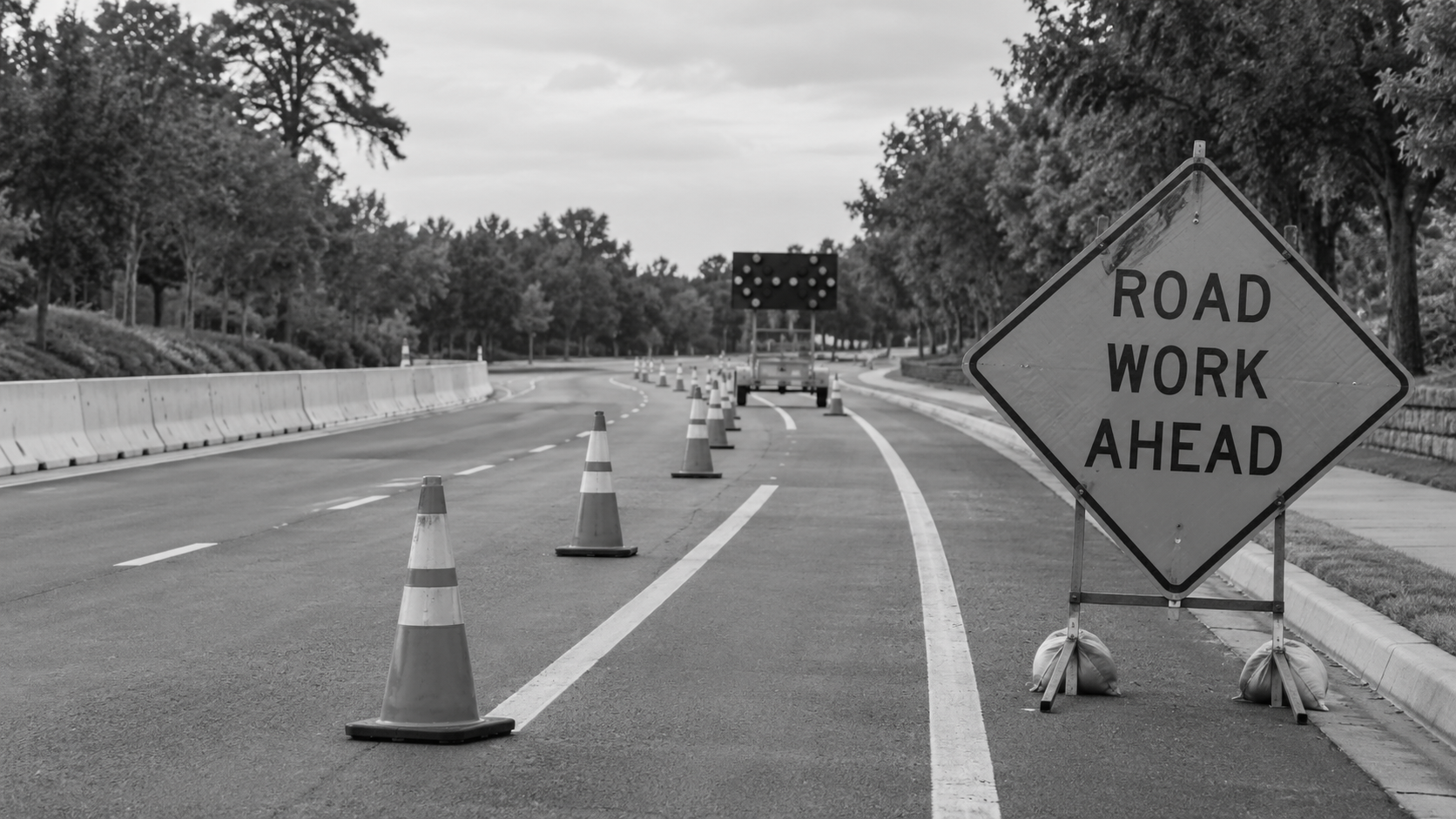
Who can be responsible for poorly marked roadwork?
Poorly marked roadwork can contribute to a crash, but the construction company is not automatically responsible simply because its name appears at the site. I need to understand what the driver encountered and who was responsible for that particular part of the work. A contractor’s failure, another driver’s conduct or a dangerous public-road condition may each require a different legal analysis.
The first account of the crash gives us a starting point. It does not necessarily tell us whether a warning was missing, whether someone moved it or whether the driver had enough time to respond. Those are facts we have to develop.
What did the driver actually see?
A close photograph of the point of impact can miss the most important part of a roadwork case: the approach. If a lane ended unexpectedly, I would want to see how the driver was directed toward that lane before reaching the construction.
Old pavement lines can conflict with temporary markings. A warning may be present but hidden behind equipment. The relevant question is not merely whether a sign existed. It is whether the arrangement reasonably communicated the hazard in time for an approaching driver to react.
Photographs taken the following afternoon may show a different setup. Work zones change as the project progresses. The date and time of each photograph matter, and an original dashcam recording may preserve conditions that no longer exist. Do not return to an active traffic lane to obtain evidence.
Who controlled the temporary traffic setup?
The company performing the excavation may not be the company assigned to place and maintain the traffic-control devices. Contracts help identify those responsibilities, but I also want to know what actually happened at the site. A written assignment and the work performed are not always the same thing.
The approved traffic-control plan can be compared with photographs and the crew’s daily records. That comparison may show whether the plan was followed or whether conditions required a change. Applicable traffic-control standards can help inform the analysis; a departure does not eliminate the need to prove causation.
This is why identifying every business whose truck was nearby is not a substitute for investigation. A viable claim must connect a particular party’s responsibility to the condition that caused the crash.
Does public ownership change the claim?
Yes. A claim against a New Jersey public entity can involve Tort Claims Act requirements and defenses that do not apply in the same way to a private driver. Formal notice is generally required within 90 days of accrual. An ordinary police report should not be assumed to satisfy that requirement.
Public-road cases can also involve statutory immunities, including issues concerning an approved design. A private contractor’s involvement requires its own analysis; neither public ownership nor the existence of a government contract answers every liability question.
I would address a possible notice deadline while investigating who controlled the work. Waiting for all the contracts before considering notice can put the claim at risk. If time has already passed, seek advice promptly rather than deciding on your own that nothing can be done.
What evidence connects the roadwork to the collision?
Even if poorly marked roadwork is established, we still need to explain how it affected this crash. A missing warning matters differently when it concealed a sudden lane closure than when the collision occurred for an unrelated reason. The other driver’s actions remain part of the investigation.
Preserve the original recording and identify witnesses who saw the approach, not just the aftermath. The location of a temporary device may be disputed later. A clear account of when and where an image was taken makes that image more useful.
My role is to put those pieces together before drawing a conclusion. The goal is a supported explanation of responsibility, rather than an assumption that construction nearby must have caused the injury.
Sources and further reading
Discuss your personal injury questions
If you have questions about a New Jersey personal injury matter, I am happy to discuss what happened and help you understand the next steps. Contact Fusco Law or call 732-INJURED (732-465-8733).
This article is general information, not legal advice. Reading it or contacting the firm does not, by itself, create an attorney-client relationship.