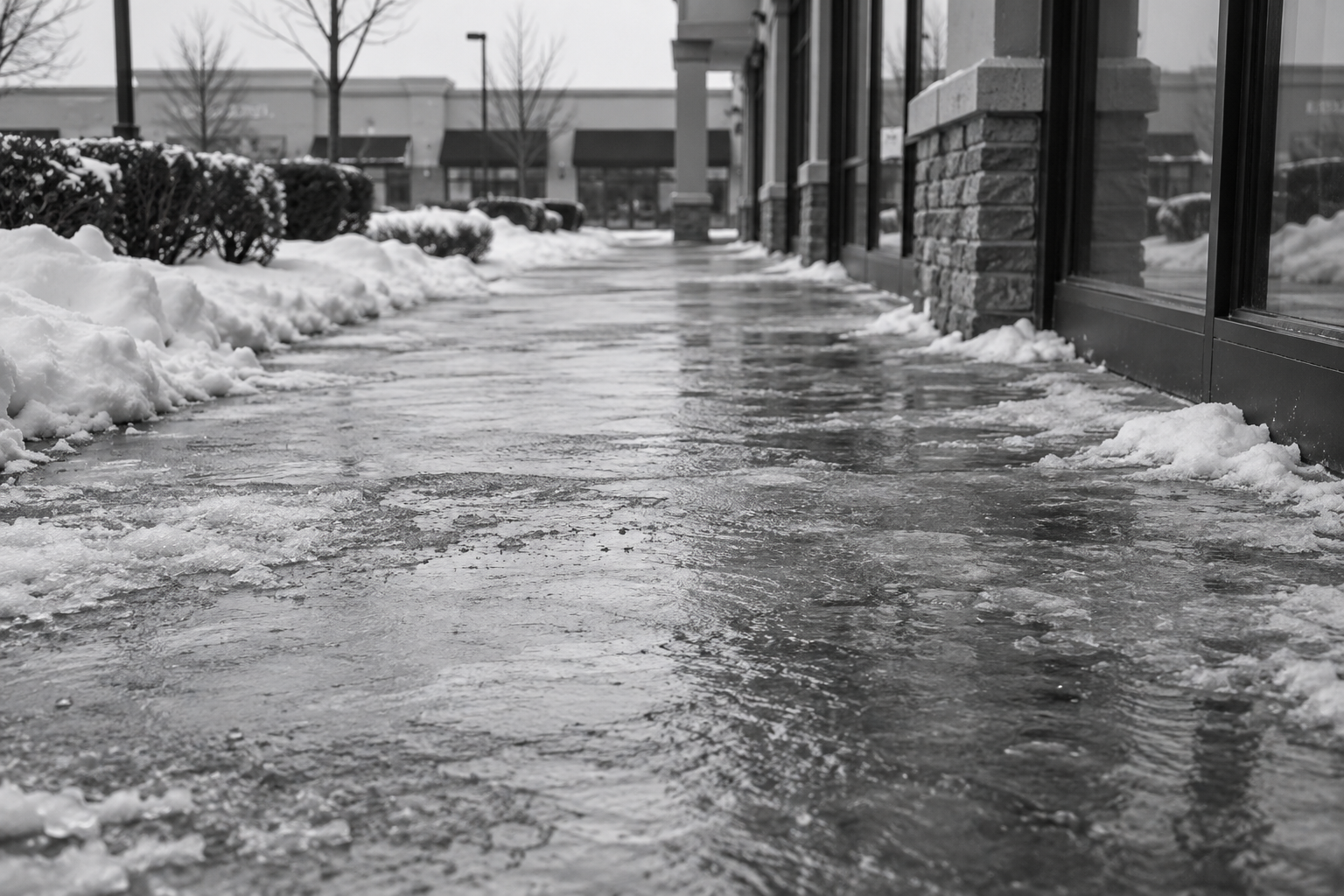
Evaluating a snow and ice fall in New Jersey
A snow and ice fall deserves a careful investigation of the property and the condition that caused it. In New Jersey, responsibility can depend on who controlled the area, when the condition developed and whether a storm was still underway. The presence of ice alone does not answer all of those questions.
Early photographs and a careful timeline can help us explain how an icy condition developed. Conditions can change quickly after a fall. A walkway may be treated or the temperature may rise before someone returns to inspect it. Preserving the available evidence early gives the investigation a firmer starting point.
This article focuses on commercial property. Public property and residential situations may involve different duties or immunities. Identifying the setting accurately is important before applying a rule intended for a different type of owner.
The ongoing-storm rule requires attention
New Jersey generally allows a commercial property owner a reasonable time after a storm ends to address snow and ice. The ongoing-storm rule can limit a claim arising while precipitation continues. The Supreme Court's Pareja decision also recognized limited exceptions involving unusual circumstances that increase the risk and certain preexisting conditions.
In July 2026, Gallardo v. Walmart reinforced that those exceptions require careful proof. Undertaking salting during a storm does not, by itself, establish an exception or make a property owner liable for every remaining icy spot. The facts must support the applicable legal theory.
That is a reason to investigate the timeline precisely. Ice left from an earlier event may present a different question from fresh accumulation during the current storm. An assumption based only on the appearance of the surface can miss that distinction.
Establish where and when the fall occurred
Identify the specific area as closely as possible. A shopping center can contain areas controlled by different businesses or contractors. The name on the nearest storefront may not establish who was responsible for maintaining the walkway or parking space.
Record the approximate time and what you observed about the weather. If someone witnessed the fall or saw the condition beforehand, retain that person's contact information. Do not ask a witness to adopt a description the witness did not actually observe.
Photographs should show the wider location as well as the surface, if they can be taken safely. Do not return to a hazardous area merely to improve the pictures. Medical attention and personal safety take priority, and other evidence may be available.
Weather records can help test the timeline
A person's recollection of precipitation is useful but may not resolve when a storm began or ended at a particular location. Weather data and an appropriate analysis may help establish the sequence. The nearest station is not necessarily a complete description of conditions at the precise site.
A period of melting followed by freezing may raise different questions from an active snowfall. Drainage and the location of earlier snow piles may also matter if the evidence connects them with the icy area. Those possibilities should be investigated rather than asserted as facts from the outset.
The relevant issue is how the condition formed and what responsibility existed at the time. A general forecast for the county or a photograph taken days later may provide context, but it should not be presented as conclusive proof of the surface where the fall occurred.
Maintenance records and contracts may identify responsibility
A commercial owner may use a management company or snow contractor. The agreements and actual work can help explain who was responsible for particular tasks. A contract alone does not necessarily answer every question about a duty owed to an injured person.
Service logs may show when a contractor attended the property and what was reportedly done. Those records can be compared with available video and witness accounts. If a record is incomplete, we need to identify that limitation rather than fill it with an assumption.
The investigation should focus on the condition involved in the fall. Evidence that a lot was treated somewhere does not necessarily establish what occurred on a particular walkway. Equally, an untreated-looking photograph does not prove that no treatment was ever applied.
Preserve the injury evidence as well
Seek appropriate medical assessment and explain how you fell and where symptoms developed. If the effects change over the following days, inform the provider. The medical account should reflect the actual course rather than an effort to make every symptom sound immediate.
Keep the footwear worn at the time and relevant communications. The defense may raise questions about the circumstances of walking through the area. Those questions should be answered with the evidence, not accepted as a reason to blame the injured person without examining the condition.
A property incident report can be useful, but it may not contain the entire account. If you receive a copy, preserve it. If you did not complete a report at the scene, explain what happened so we can consider other ways to establish the event.
A focused review is more useful than a quick conclusion
These cases require attention to current law and specific facts. We should explain which duty may apply and what evidence is still needed. A serious injury warrants a thoughtful review, even when the legal analysis is demanding.
Bring the photographs and information you have without waiting for a perfect file. An early discussion can help identify preservation steps and determine whether the condition supports a viable claim. The objective is to evaluate your experience fairly and pursue the path the evidence can support.
Sources and Further Reading
About Michael B. Fusco
Michael B. Fusco is a New Jersey personal injury attorney certified by the Supreme Court of New Jersey as a Civil Trial Attorney. Read Mike’s biography and credentials.
Discuss Your Personal Injury Questions
If you have questions about an injury in New Jersey, I am happy to discuss what happened and the options the facts may support. You do not need to have every document or answer before contacting us. Call 732-465-8733 or contact Fusco Law for a free personal injury consultation.
General Information
This article provides general information, not legal advice for a particular situation. Laws and policy terms must be applied to the actual facts. Reading this article or contacting the firm does not, by itself, create an attorney-client relationship.